When Your E-commerce Platform Can No Longer Keep Up With Your Business
Here’s Why manufacturers and industrial distributors are exploring custom B2B e-commerce solutions.
Imagine running a growing industrial equipment company. Your business supplies hundreds or thousands of products to contractors, distributors and other businesses. Some customers receive negotiated pricing. Others purchase in bulk, request quotations or require specialized equipment configurations. Your sales team knows these customers personally. They understand their purchasing requirements, preferred products and negotiated terms.But your e-commerce platform doesn't.
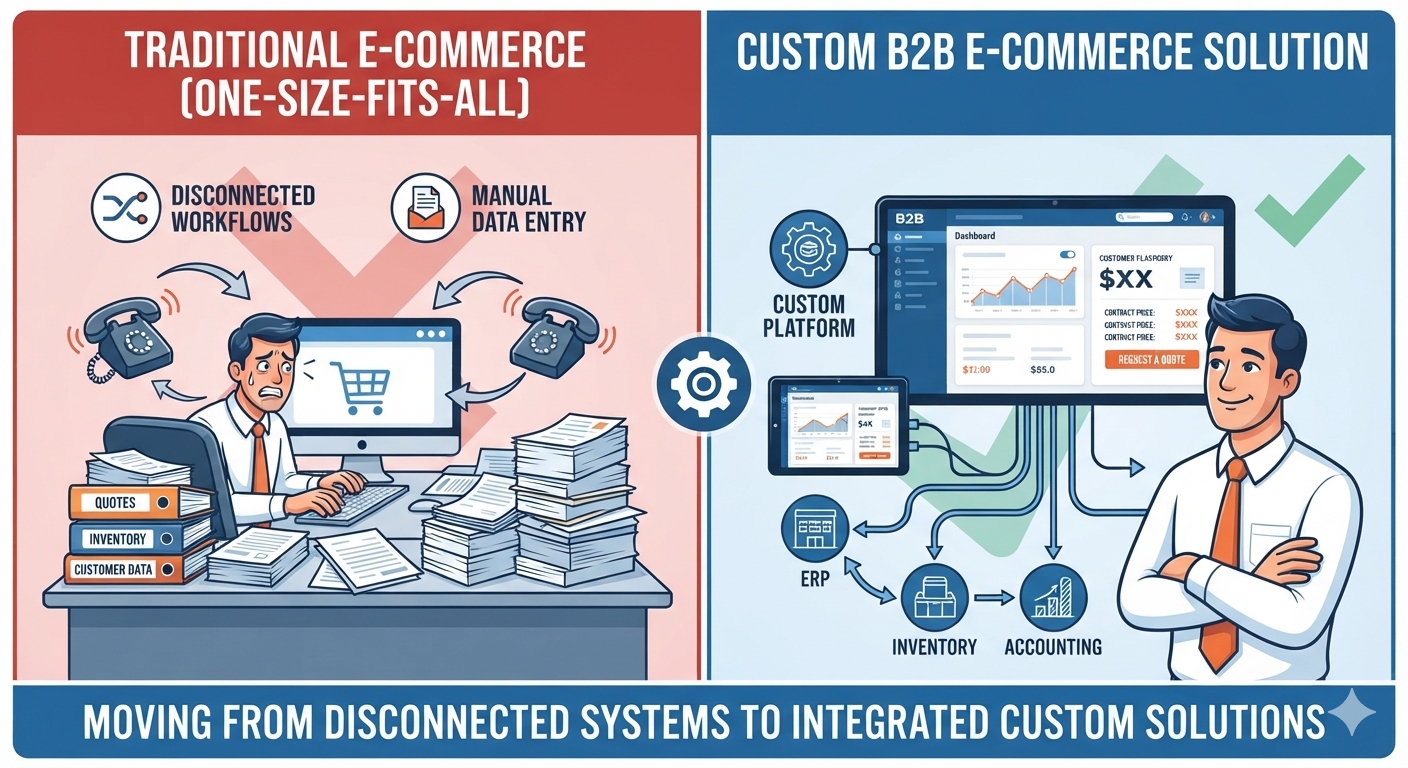
Every time a customer needs something outside the standard purchasing process, they must call or email your sales team. Your employees manually prepare quotations, verify inventory, calculate discounts and enter orders into other business systems. The website generates enquiries, but much of the actual selling still happens offline. Sound familiar?
For many industrial businesses, the challenge isn't necessarily a lack of technology. It's that their existing technology doesn't fully support how they operate.
The problem with one-size-fits-all e-commerce
Traditional e-commerce platforms can be excellent solutions for businesses selling standard products through straightforward purchasing processes. However, industrial B2B purchasing can involve additional complexity. Consider these everyday scenarios:
- A distributor requires different pricing from a retail customer.
- A contractor wants to reorder 50 previously purchased products without searching the entire catalogue.
- A procurement manager needs a formal quotation before obtaining internal purchase approval.
- A manufacturer sells equipment with multiple configurations and optional components.
- A customer places an order online, but employees must manually enter the same information into an ERP or inventory system.
Many established e-commerce platforms support some of these requirements through native features, extensions or integrations. But as requirements become increasingly specialized, businesses may find themselves managing multiple applications, workarounds and disconnected workflows.
The question becomes: Should your business continue adapting its processes to its software, or should your software be designed around your business?
A different approach: Custom B2B e-commerce
Rather than starting with a predefined online store, custom development begins by understanding how a business actually operates.
- What information do customers need before purchasing?
- How are quotations prepared?
- How are different customer accounts and pricing agreements managed?
- Which existing systems need to communicate with the website?
- Once these questions are answered, a solution can be designed around the company's specific requirements.
For example, a custom B2B e-commerce platform could provide:
1. A purchasing experience designed for industrial customers.
Instead of a generic shopping cart, customers could access specialized product catalogues, request quotations, manage repeat orders and view account-specific pricing.
2. Better connections between business systems
A custom platform can be designed to exchange information with existing inventory, ERP, accounting and order-management systems, reducing duplicate data entry and improving information flow.
3. Greater flexibility as requirements evolve
New purchasing workflows, customer account structures, product configuration tools and integrations can be developed as business needs change.
Where React and Java fit into the picture
Continuum Digital has developed an ecommerce demonstrator using a React frontend connected to a Java backend. React enables developers to build interactive user interfaces tailored to particular purchasing workflows. Java can support backend services responsible for business logic, data processing and integrations. Together, these technologies can form the foundation of a custom ecommerce application
Explore our React ecommerce demo
See an example of the technical foundation we can build upon for a customized ecommerce project. View Demonstration
Let's explore what's possible for your business
Whether you're a manufacturer, industrial equipment supplier or distributor, improving your digital purchasing experience begins with understanding your customers and existing operations. Our team can review your requirements, evaluate your current systems and identify potential solutions. For suitable projects, we can also prepare a tailored proof-of-concept to demonstrate how specific requirements could be addressed before proceeding with a larger implementation. Interested in exploring your options?
Connect with Audrey Yates at Facetime Presentations to arrange an introductory discussion with Continuum Digital.


